
Pipeline Operator Eliminates Venting from Gas-powered Pneumatic Valves Using ZD3 Technology
Customer
North American Transmission Operator
Jobsite
Compression Station in Midwest USA
Objective
Eliminate methane venting from pneumatic control valvesSolution
ZD3 Closed-Vent Compressor (M1)
THE CHALLENGE
A 1980s-Era Station with 20 Gas-Powered Pneumatic Control Valves — All Venting Methane
Gas-powered pneumatic control valves are among the largest sources of routine methane emissions from midstream pipeline infrastructure. By some estimates, 15–20 billion cubic feet (Bcf) of transient methane emissions are attributed to pneumatic devices in U.S. natural gas transmission annually.
The station at the center of this project was commissioned in the mid-1980s and operates 10 primary control (worker) valves and 10 monitoring valves — all pneumatically actuated. Tightening EPA Subpart OOOOb regulations, combined with voluntary ESG commitments to eliminate routine venting, put the operator under pressure to act.
"The operator had plans to upgrade the station by replacing all 20 pneumatic valves over 1–2 years. The primary motivations: eliminate routine venting, achieve OOOOb compliance, and create a safer working environment for station personnel."
Subpart OOOOb is the EPA's emissions standard for the oil and natural gas sector, requiring operators to detect, reduce, and in many cases eliminate methane emissions from equipment including pneumatic controllers, compressors, and storage vessels. For transmission pipeline operators, compliance increasingly means replacing or capturing exhaust from gas-powered pneumatic devices or facing mandatory reporting and potential penalties.
ESG & Emissions Targets
Internal commitments required eliminating all routine venting at the facility.
Regulation Compliance - EPA Subpart OOOOb
Upcoming state and federal mandates required a certified closed-vent system (CSV) solution in place.
Worker Safety
Continuous methane exhaust created hazardous atmospheric contitions for station personnel.
Electric Actuators Were Uneconomical
Transitioning to electric actuators meant long valve lead times, high capital costs, and complex grid interconnection
THE SOLUTION
ZD3 Closed-Vent Compressor Powered Entirely by Station Differential Pressure
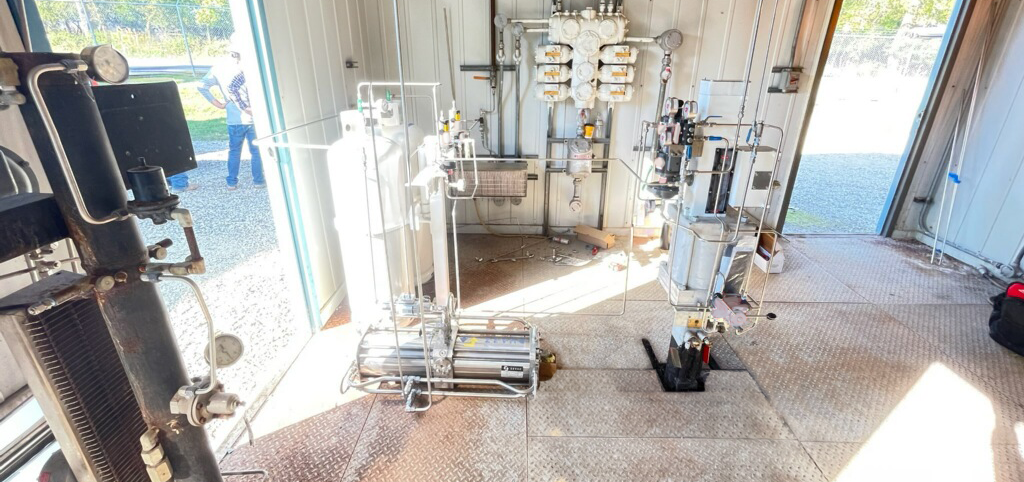
Rather than undertaking a costly electrical conversion, the operator deployed ZEVAC's ZD3 Closed-Vent Compression System (M1 model) as a pilot on a single pipe run. The goal: validate the technology over seven months before a full-station rollout.
The ZD3 uses ZEVAC's patented pressure exchanger technology — differential pressure between the station's discharge and suction headers serves as the sole motive force, driving linear reciprocating pistons to capture and compress vent gas back into the power gas supply. No electrical power, VFDs, combustion, or external energy source required.
-
Step 1Vent Gas CollectionA ½-inch vent line routes exhaust from the pneumatic valve positioner to an accumulator tank, capturing gas that would otherwise vent to atmosphere.
-
Step 2Drive Gas ConnectionThe ZD3 drive gas inlet taps into the upstream header (~600 psig). The drive gas outlet connects to the downstream header (~300 psig), creating the differential pressure that powers the unit.
-
Step 3Automatic ActivationWhen accumulator pressure reaches 20 psig, the ZD3 activates automatically, compressing vent gas into the power gas supply. It deactivates at 10 psig — cycling approximately every 3–4 minutes.
-
Step 4Zero-Emission ReinjectionCaptured vent gas is recompressed and reinjected into the station system — achieving a true closed-vent system with no methane release to atmosphere.
Site Configuration
| Paramater | Value |
| Product | ZD3 Closed-Vent Compressor (M1 model) |
| Connection size | ½-inch (all connections) |
| Drive Gas Inlet Pressure | ~600 psig (upstream tap) |
| Drive Gas Outlet Pressure | ~300 psig (downstream tap) |
| Activation Pressure | 20 psig (accumulator) |
| Deactivation Pressure | 10 psig (accumulator) |
| Standard Operating Temperature Range | -10° to 250° F |
| Cycle Frequency | Approximately every 3-4 minutes |
| Installation Time | ~Half a day (1 ZEVAC technician) |
PROJECT RESULTS
Seven Months With Zero Downtime — and a Full Station Rollout Underway
The single ZD3 pilot unit has operated for seven months without complications or downtime. Methane emissions from the double-acting pneumatic device — cycling every ~30 seconds at 1.0% travel — have been fully eliminated.
Based on the pilot's success, the operator is proceeding with installation of 10 ZD3 units across each of the station's pipe runs over the next year. Full build-out is projected to mitigate over 4 million SCF of methane emissions annually from the facility.
Routine venting from pneumatic control valves eliminated, meeting ESG targets
Classified as a Closed-Vent System under EPA subpart OOOOb, avoiding reporting requirements
Station personnel no longer exposed to hazardous methane atmosphere
Scalable to sensitive urban locations where atmospheric venting is prohibited or requires special permitting
No electrical infrastructure upgrades required - deployed on a brownfield station without grid access
ABOUT THE PRODUCT
ZD3 Closed-Vent Compressor
The ZEVAC ZD3 is purpose-built for permanent, facility-based vent gas recovery from gas pneumatic actuators, rod packings, unit blowdowns, and filter separators. Powered entirely by station differential pressure, it requires no external energy source and qualifies as a closed-vent system under EPA Subpart OOOOb.
Key Product Features
-
Zero external power - driven by station gas differential pressure (0-1480 psig)
-
No inlet gas regulation requirements
-
Simple mechanical installation - complete in less than 1 day
-
Redundant and adjustable pressure control protection
-
Closed-Vent System (CVS) - EPA Subpart OOOOb compliant
-
Tolerates liquid ingestion
-
Optional auxiliary air-drive capability when gas dP is unavailable
-
Intrinsically safe design - no combustion or rotating components